
01
The Event
July 16, 1996. The recovery room. The cardiac arrest. The resuscitation.
A Personal Memoir
A physician. A patient who died. A system that turned on the doctor who tried to save her.
The true story of how medicine, politics, and power destroyed a career — and nearly a life.

"Walking into the recovery room and observing my patient on the verge of cardiac arrest and death on July 16, 1996 — this is another such event emblazoned in my memory."
On an ordinary summer morning in Greenville, Michigan, Dr. Jeffery Askanazi — a board-certified physician trained at some of the country's finest medical centers — rode his bicycle to work. He performed surgery. He walked into the recovery room. What he found there would set in motion three years of investigation, prosecution, and institutional warfare.
His patient, Deb Wasko, had suffered cardiac arrest. Oxygen saturation at 53%. Flat line on the monitor. Dr. Askanazi resuscitated her — a 15 to 20-minute battle using CPR, epinephrine, and multiple defibrillations. She was stabilized. She was transferred. A neurosurgeon said she was improving.
Then, on a Sunday afternoon, with no ethicist, no second opinion, no proper protocol in place — Deb was removed from life support. She died within hours. Dr. Askanazi arrived home to a voicemail. He would spend the next year trying to understand what had happened. He would spend the years after that being destroyed for asking.
What unfolded was not a medical tragedy. It was a deliberate institutional campaign — involving medical boards, prosecutors, and the statewide influence of a powerful hospital — to silence a physician who had seen too much.
The Event
Deb Wasko suffers cardiac arrest post-surgery. Dr. Askanazi resuscitates her. She is removed from life support on a Sunday afternoon without proper protocol.
The Investigation
Dr. Askanazi begins uncovering irregularities. The licensure hearing begins. Institutional forces mobilize against him.
The Arrest
Federal charges. A trial. Physician inquisitors. A verdict that defied the evidence.
The Aftermath
Prison. Rebuilding. And finally — the truth, written in full.
This is not a story about a medical error. Dr. Askanazi's surgical outcome was defensible. The resuscitation was textbook. The real crime, as he came to understand it, was asking questions — and having the analytical skill to find answers that powerful people didn't want found.
What this memoir documents — in careful, clinical detail — is how a regional hospital system leveraged its institutional power to recruit medical boards, prosecutors, and the federal government against one physician. How witnesses testified falsely. How evidence was shaped. How a man was imprisoned for doing his job.
It also documents what it cost: his practice, his freedom, his family's stability. And what it took to survive it — and emerge with clarity about what really happened in Michigan.
How licensure hearings are weaponized and physician inquisitors operate outside normal evidentiary standards.
The mechanics of a case built not on guilt but on institutional influence — and what Darth Vader and Cruella DeVil have to do with it.
The statewide, possibly national influence of Butterworth Hospital — and how that power shaped every outcome in this case.
From FCI Beckley to rebuilding a life. The human cost — and what endures when nearly everything is taken.
From a single morning in a recovery room to the federal prison system — and everything in between.
July 16, 1996. The recovery room. The cardiac arrest. The resuscitation.
Greenville, Michigan — a community portrait that explains everything that follows.
Who she was. What the surgery was. What really happened to her.
How it occurred — and Dr. Askanazi's year-long effort to reconstruct the truth.
The cast of institutional actors who mobilized against him — named and described.
The first arena. How medical boards operate when power is involved.
Federal charges arrive. A physician becomes a defendant.
Inside the courtroom. Who testified and what they said.
What a federal investigation does to a life — financially, personally, professionally.
The prosecution's case, its weaknesses, and the evidence suppressed.
The expert witnesses who testified — and the questions their testimony raises.
What the defense argued. What evidence was available. What justice required.
The outcome. And what it reveals about the system that produced it.
The immediate consequences. What comes after a conviction that shouldn't exist.
Post-verdict legal work. The appeals. The continued fight.
FCI Beckley. Federal prison as experienced by a physician.
What was lost. What remained. What the system could not take.
The institutions that acted without accountability — and why that matters beyond one case.
Although I was initially pleased with my analytical processes, which left me rather self-satisfied, events were to prove certain facts better left uncovered.
— Jeffery Askanazi, M.D. · Murder in Michigan
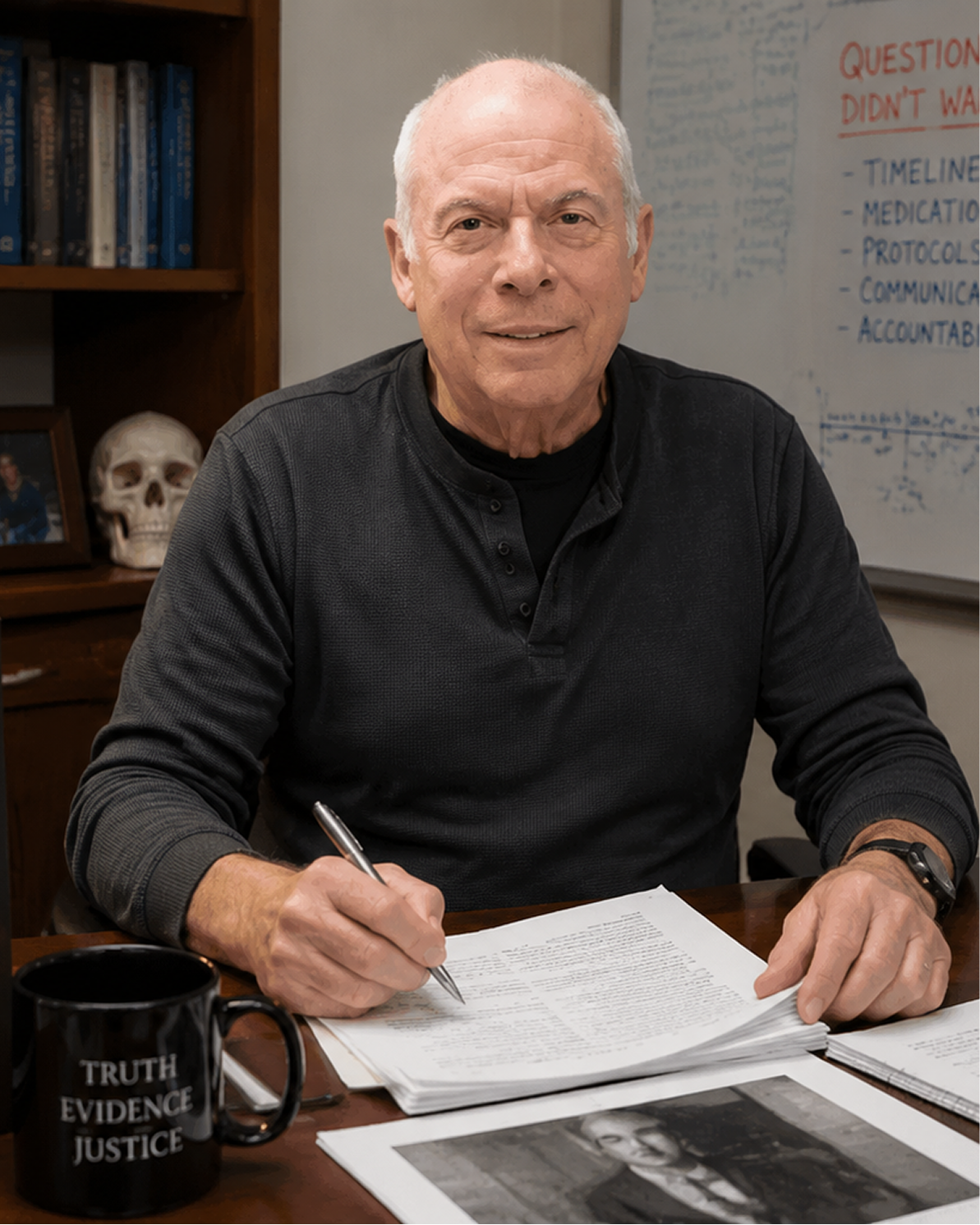
A memoir that reads like a legal thriller — because it is one. Available in paperback, hardcover, and ebook from all major retailers.